

Windows How To Check Uptime
On Windows 10, understanding how long a device has been up and running can be useful information in a number of scenarios. For instance, when troubleshooting problems, you may want to know if a reboot was recently applied, or if your reckoner is acting up while working on an important project, and you suspect a restart is required.
Whatever the reason, Windows 10 doesn't make information technology obvious to come across your organization uptime, just it's not impossible to find either, as y'all can deduce this data using Task Director, Control Panel, Command Prompt, and PowerShell.
In this Windows 10 guide, we walk you through four simple ways to check your device uptime without involving scripts or restarting.
- How to check PC uptime using Task Managing director
- How to check PC uptime using Control Console
- How to check PC uptime using Command Prompt
- How to bank check PC uptime using PowerShell
How to cheque PC uptime using Task Director
Perhaps the easiest mode to check your device uptime is using Task Manager with these steps:
- Open Start.
-
Search for Task Manager and click the top result to open up the experience.
Quick Tip: You tin can likewise open Task Manager using the Ctrl + Shift + Esc keyboard shortcut, or by correct-clicking the taskbar and selecting Task Manager from the menu.
- Click the More details button (if y'all're using the compact view).
- Click the Performance tab.
-
Select the CPU section.


Once you complete these steps, yous'll meet your device uptime on the right side, at the lesser of the page.
How to check PC uptime using Command Panel
Another easy way to decide your organization uptime is to check your network adapter condition with these steps:
- Open Start.
- Search for Control Panel and click the elevation result to open the experience.
-
Click on Network and Internet.

-
Click on Network and Sharing Center.

-
Click the Change adapter settings option in the left pane.

-
Double-click the network adapter continued to the internet.


Afterward completing the steps, you lot can deduce your computer uptime using the "Duration" information, which indicates the uptime from the network connection that resets every time the device starts. (Of grade, these methods work as long as you didn't reset your network connexion since the last fourth dimension you booted the device.)
How to check PC uptime using Command Prompt
If yous want to use Command Prompt to cheque your device uptime, you accept at to the lowest degree two means to do it.
Using WMIC
To check your computer uptime using Command Prompt, employ these steps:
- Open Start.
- Search for Control Prompt, correct-click the elevation result, and click the Run as ambassador option.
-
Blazon the following command to query the device'southward last boot time and press Enter:
wmic path Win32_OperatingSystem become LastBootUpTime

In one case y'all complete these steps, you'll notice an output that can look intimidating, but information technology'due south not difficult to decode and then you tin can understand your device uptime.
For example, the LastBootUpTime 20181219104602.500000-300 can be broken down using the info below.
- Twelvemonth: 2018.
- Month: 12.
- Twenty-four hour period: 19.
- Hour: x.
- Minutes: 46.
- Seconds: 02.
- Milliseconds: 500000.
- GMT: -300 (5 hours alee of GMT).
This ways that the reckoner has been up and running since December 19, 2018, at 10:46 AM. If you want to be more specific, only subtract the last boot fourth dimension with the electric current time to deduce the number of days, hours, and minutes the device has been in operation.
Using System Data
You tin too meet your system uptime with a more user-friendly format using the System Information tool with these steps:
- Open Start.
- Search for Command Prompt, right-click the summit event, and click the Run every bit ambassador selection.
-
Type the following control to query the device's final boot time and press Enter:
systeminfo | find "Organization Boot Time"

Using the Organization Data tool, you can quickly discover out the final fourth dimension your system rebooted in an piece of cake-to-read format. Likewise, like the wmic command, you can subtract the final kick time with the current time to determine the number of days, hours, and minutes the device has been running.
How to cheque PC uptime using PowerShell
It's also possible to check your device uptime using PowerShell with these steps:
- Open Kickoff.
- Search for Control Prompt, right-click the peak upshot, and click the Run equally administrator option.
-
Type the following command to query the device uptime and press Enter:
(get-date) - (gcim Win32_OperatingSystem).LastBootUpTime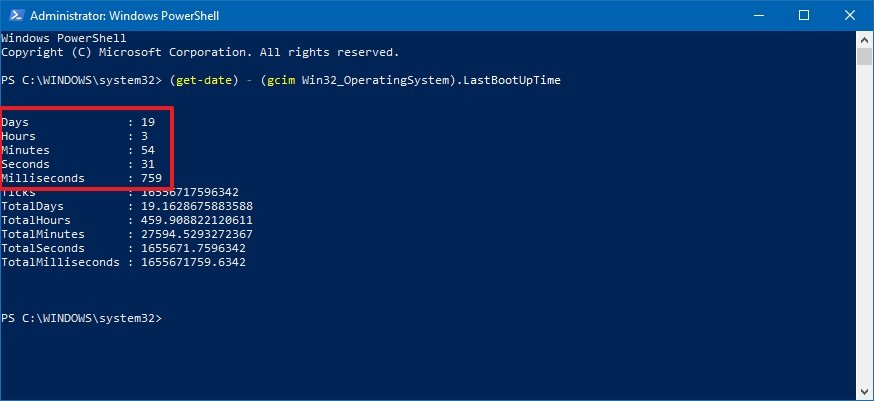

After completing these steps, you'll get the uptime data on a list format with the days, hours, and minutes.
This guide outlines several ways to check your device uptime, merely information technology's important to note that there are many other methods to notice the same information using Command Prompt and PowerShell scripts. Yet, these are the nearly straightforward methods.
In addition, while these instructions are focused on Windows 10, these methods have been around for a long fourth dimension, which means they'll also work on Windows 8.1 and Windows 7.
More Windows ten resource
For more helpful articles, coverage, and answers to common questions about Windows 10, visit the following resources:
- Windows 10 on Windows Central – All you need to know
- Windows x assistance, tips, and tricks
- Windows x forums on Windows Central

Sun Valley ii
The next large Windows eleven update: What y'all demand to know
Microsoft is hard at piece of work on the next major version of Windows eleven. Dubbed "version 22H2", this side by side release is expected to ship in the second half of 2022, and is already in testing with Windows Insiders in Microsoft's active development branches. Here's everything you need to know.
Source: https://www.windowscentral.com/how-check-your-computer-uptime-windows-10
Posted by: eisenhauerbript1952.blogspot.com
0 Response to "Windows How To Check Uptime"
Post a Comment